
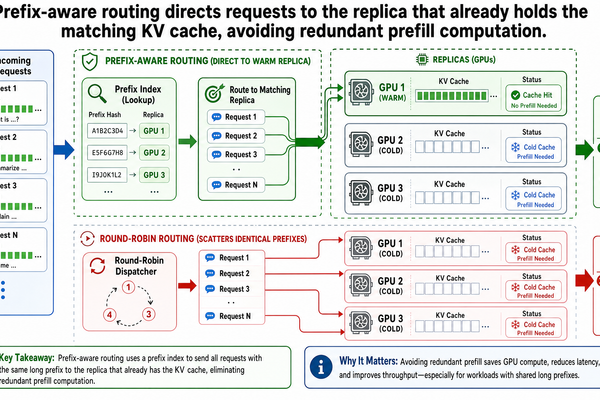
前綴感知路由:考量快取狀態的請求分配
在 I-02 篇中,我們看到 PagedAttention 讓不同的請求能在同一個模型副本(model replica)上共用物理 KV 快取區塊。兩個使用相同系統提示詞(system prompt)的請求可以指向相同的物理區塊,不需要儲存重複的副本。這個共用機制確實有效——但前提是兩個請求必須落在同一個副本上。
Huang Tzu Lin
8 posts
在 I-02 篇中,我們看到 PagedAttention 讓不同的請求能在同一個模型副本(model replica)上共用物理 KV 快取區塊。兩個使用相同系統提示詞(system prompt)的請求可以指向相同的物理區塊,不需要儲存重複的副本。這個共用機制確實有效——但前提是兩個請求必須落在同一個副本上。
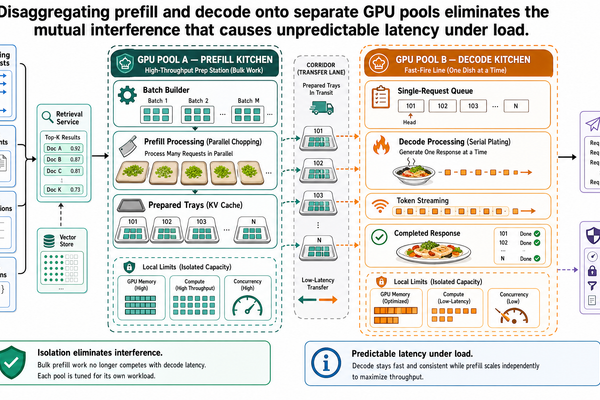
I-00 確立了 LLM 推論具有兩個資源特性截然不同的階段。預填充以平行方式處理所有輸入 token,屬於運算瓶頸(compute-bound)——GPU 的運算單元是限制因素。解碼則逐一生成 token,屬於記憶體頻寬瓶頸(memory-bandwidth-bound)——限制因素在於從 GPU 記憶體讀取模型權重和 KV 快取的速度。I-01 介紹了連續批次處理,它透過在迭代層級而非批次層級進行排程,讓 GPU 保持滿載。I-02 則展示了 PagedAttention 如何消除記憶體浪費,讓更多請求能同時處於活躍狀態。
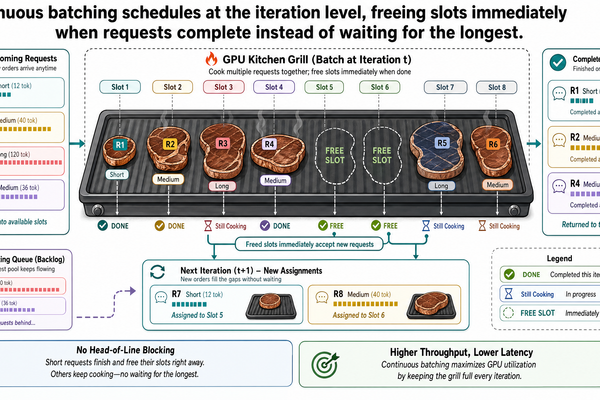
I-00 追蹤了單一請求通過推論流程的完整路徑:預填充(prefill)以平行方式處理所有輸入 token,解碼(decode)逐一生成輸出 token,而 KV 快取(key-value cache)隨著每一步不斷增長。在那篇文章的結尾,我們注意到還有 49 個其他代理人幾乎同時提交了查詢。這個觀察不是隨口帶過——它直接指向推論服務的核心運作問題。
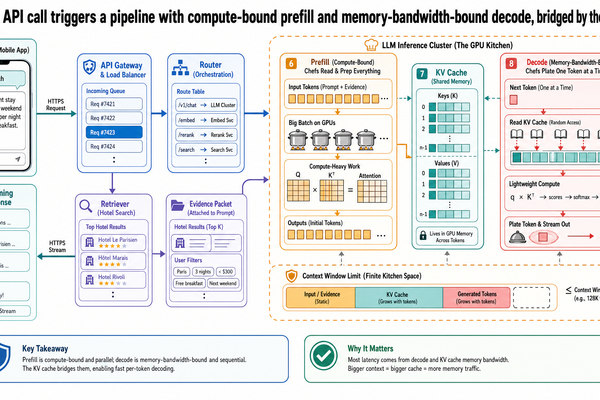
你已經建好一個旅遊小助理。使用者輸入一段查詢,你的應用程式把它送到 LLM 供應商的 API,幾秒後回應串流回來。對應用程式開發者來說,那就是一次函式呼叫。但從基礎設施的角度來看,這一次呼叫觸發了一整條流程(pipeline),牽涉到不同的運算階段、專用的記憶體結構、排程決策,還有硬體限制。這些因素加在一起,決定了使用者實際感受到的延遲、吞吐量和成本。
In Post I-02, we saw that PagedAttention enables different requests to share physical KV cache blocks on the same replica. Two requests with the same system prompt can point to the same physical blocks rather than storing duplicate copies. That sharing mechanism is real and it works -- but only i...
Post I-00 established that LLM inference has two phases with fundamentally different resource profiles. Prefill processes all input tokens in parallel and is compute-bound -- the GPU's arithmetic units are the bottleneck. Decode generates tokens one at a time and is memory-bandwidth-bound -- the ...
Post I-00 traced a single request through the inference pipeline: prefill processed all input tokens in parallel, decode generated output tokens one at a time, and the KV cache grew with every step. At the end of that trace, we noted that 49 other agents were submitting queries at roughly the sam...
You have built a travel copilot. A user types a query, your application sends it to an LLM provider's API, and a few seconds later a response streams back. From the application developer's perspective, that is one function call. From the infrastructure's perspective, that function call triggers a...